

Ashkenazi Jewish families play an important role in Parkinson’s research. Certain genetic changes linked with the disease are more common in this community. By taking part in research studies, people are turning their heritage into hope — and helping scientists learn how to stop brain disease.
The Michael J. Fox Foundation’s landmark study is looking at this connection and invites people from the community to join us by taking a simple smell test.
What Is the Link Between Ashkenazi Jewish Heritage and Parkinson’s?
People with Ashkenazi Jewish ancestry share a close family history, which makes some genetic changes more common. Two important genes connected to Parkinson’s disease are:
- LRRK2 — About one in seven Ashkenazi Jewish people with Parkinson’s carries a change in this gene.
- GBA — The most common genetic risk factor for Parkinson’s overall, GBA changes are also more common in Ashkenazi Jewish families.
Having a change in either of these genes does not mean someone will develop Parkinson’s. Many people with these changes never get the disease. Scientists are working hard to understand what other factors — including age, environment or lifestyle — affect who develops Parkinson’s.
-
What the Numbers Show
Scientists have studied how likely it is for Ashkenazi Jewish people with these gene changes to develop Parkinson’s:
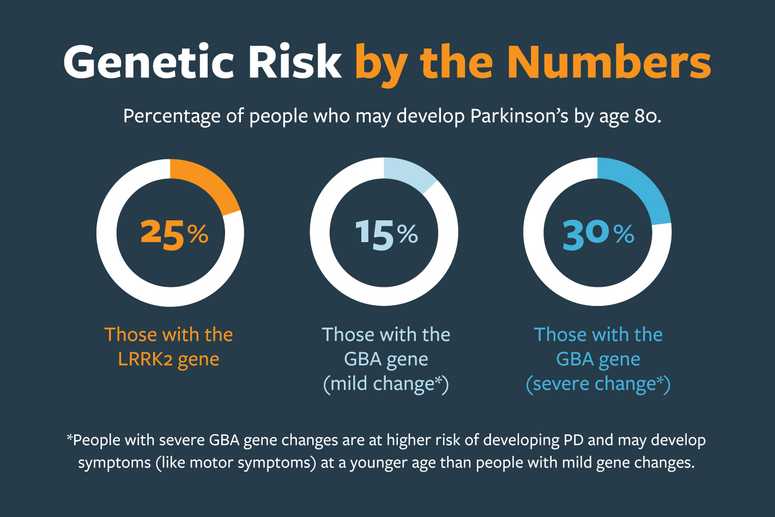
Not everyone with gene changes develops Parkinson’s Disease — but people with gene changes do have a higher chance than people without gene changes.
-
What Research is Being Done to Understand Genetic Links to Parkinson’s?
The Michael J. Fox Foundation leads a major study called the Parkinson’s Progression Markers Initiative (PPMI). This study collects data from people with and without Parkinson’s to learn how the disease begins and changes. Because LRRK2 and GBA changes are more common in the Ashkenazi Jewish community, people with this heritage are especially important to the study. By taking part, participants help researchers find early signs of Parkinson’s and develop new treatments aimed at specific genetic causes.
PPMI needs people with and without Parkinson’s disease. The first step in enrollment is a smell test, as smell loss can also be an early sign of disease. Some people with Parkinson’s may be offered a genetic test too. Learn more at mysmelltest.org.
Stories from Our Community
People like you are making a difference by joining research:
-

Rick Grant
Within weeks of his diagnosis, Rick enrolled in PPMI. His motivation was simple: “To stamp out Parkinson’s.”
-

Sherry and Her Family
Living with Parkinson’s and a LRRK2 change, Sherry joined PPMI for herself, also her children who carry the gene change and her mother, who lived with the disease.
-

Jerry Pollack
Jerry honors his father, brother and sister—all diagnosed with Parkinson’s — by joining PPMI.
-
Trials Testing New Gene-Based Treatments
Treatments to slow Parkinson’s by working on the LRRK2 and GBA pathways are in clinical trials. Click through to learn more about the studies and contact their teams.
- Denali Therapeutics is testing a drug to lower LRRK2 activity in people with a LRRK2 gene change.
- Neuron23 has a trial of a LRRK2 activity-lowering drug.

How's Your Sense of Smell?
Contribute to breakthroughs in Parkinson's research by taking a scratch-and-sniff smell test. It’s free, mailed to your home and takes just 15 minutes to complete.