

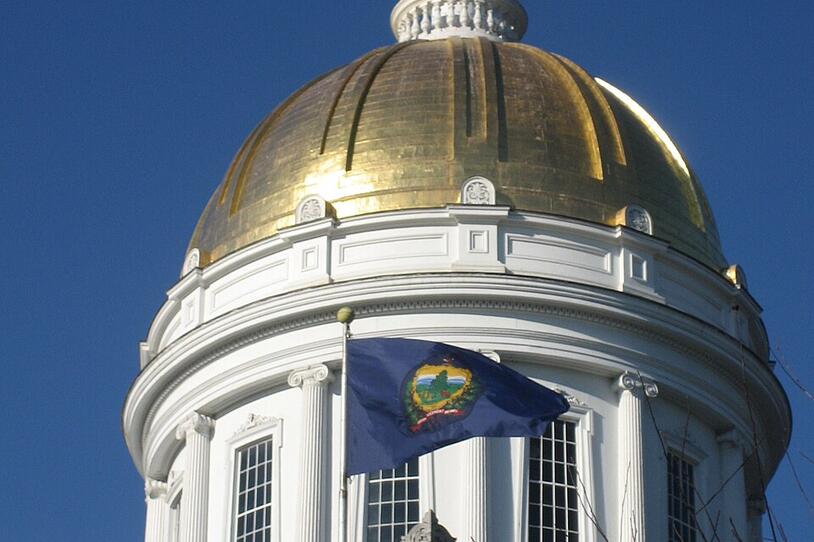
Vermont state capitol building.
Editor’s note: On Tuesday, May 26, 2026, Vermont Governor Phil Scott signed H. 739 into law, making Vermont first in the United States to ban paraquat, a pesticide linked to increased Parkinson’s disease risk.
Upon signing the bill, Governor Scott said: “Today, I signed H.739, which phases out the use of the harmful herbicide paraquat over the coming years. I appreciate Michael J. Fox and his Foundation for their work on this issue and hope this can serve as a model for other states to follow.”
On May 13, 2026, Vermont lawmakers passed bipartisan legislation to ban paraquat — becoming first in the nation to address this toxic pesticide that increases Parkinson’s disease risk. Next, the bill will be delivered to Governor Phil Scott (R), who will have 10 days to sign it into law once it reaches his desk.
“I’m grateful to the patients, advocates, lawmakers and scientists who stepped up to protect Vermonters from paraquat,” said Michael J. Fox. “Now it’s time for other states — and Washington — to do the same.”
A Preventable Environmental Risk Linked to Parkinson’s
Paraquat is a highly toxic pesticide used on farms across the United States. Decades of scientific research show that people who apply paraquat are more than twice as likely to develop Parkinson’s disease compared to those who use other pesticides. Even living or working near areas where paraquat is sprayed can raise Parkinson’s risk, underscoring concerns about the chemical’s impact on farmers, agricultural workers and rural communities.
Despite being banned by more than 70 countries globally, including China and the European Union, the U.S. Environmental Protection Agency (EPA) allows paraquat to be used in the United States. The EPA has designated paraquat as a restricted-use pesticide, meaning it can only be applied by licensed applicators. Even so, concerns about accidental or airborne exposure and long-term health impacts have persisted for decades.
In late 2022, the EPA announced a reassessment of paraquat’s safety, which remains incomplete as of May 2026. For more than 10 years, The Michael J. Fox Foundation (MJFF), together with its nationwide network of policy advocates and coalition partners, has led the push for a federal paraquat ban. We continue to urge the EPA to complete its long-pending paraquat review and take action consistent with the science.
“The evidence linking paraquat exposure to increased Parkinson’s risk is strong and has been building for decades,” said Dan Feehan, MJFF’s chief policy and government affairs officer. “Vermont’s leadership sends a clear message: We do not have to wait to act. Other states should follow Vermont’s lead — and the federal government has an obligation to protect all Americans with a national paraquat ban.”
“The federal government has an obligation to protect all Americans with a national paraquat ban.”
Vermont Responds to Growing Body of Scientific Evidence
In response to the evidence of paraquat’s harm, Vermont lawmakers took action to protect public health at the state level. Their bill, H. 739, will end the sale and use of paraquat in late 2026, with a phased transition for certain crops until a full statewide ban takes effect in December 2030. The legislation also provides a transition period to give farmers time to consider and adopt safer, effective and economically viable alternatives to paraquat, ensuring that agricultural communities can move forward without disruption.
“I spent 30 years as an exercise physiologist helping people get stronger,” said Ron McConnell of Vergennes, Vermont, who lives with Parkinson’s and testified in favor of the bill. “In 2017, a toxic exposure changed my life, and Parkinson’s followed. There is no cure for this disease yet. Until there is, addressing preventable risk is the strongest tool we have. I’m proud of my home state of Vermont for leading the way.”
“There is no cure for this disease yet. Until there is, addressing preventable risk is the strongest tool we have. I’m proud of my home state of Vermont for leading the way.”
This moment marks a major public health victory and the result of sustained advocacy across the Parkinson’s, environmental and public health communities. To secure the bill’s introduction and successful passage, MJFF’s Public Policy team worked closely with Vermont legislators, the Environmental Working Group, Vermont Public Interest Research Group and advocates like Ron McConnell and Dr. James Boyd, a neurologist and professor at the University of Vermont. Advocates showed up at every stage of the process — providing legislative testimony, writing op-eds and contacting lawmakers to build momentum for passage.
Vermont’s action may serve as a model for other states considering similar measures. In 2026 alone, MJFF is working on paraquat legislation in a dozen states including New York, Pennsylvania and Minnesota. More are expected to follow as prioritizing brain health becomes an increasingly urgent policy focus for state legislatures. Together, we’re driving a growing bipartisan effort to act on toxic exposures.
Congress Protects State Ability to Ban Paraquat
Momentum at the state level is now being reinforced by action in Congress. On April 30, 2026, the U.S. House of Representatives passed a bipartisan amendment to the federal Farm Bill that protects states’ ability to set their own safeguards around pesticides. The Farm Bill is a major piece of federal legislation that shapes agriculture policy nationwide, and earlier versions included language that could have made it more difficult for states to act on dangerous pesticides like paraquat.
MJFF advocated for the amendment by joining other Parkinson’s disease organizations in a joint letter urging members of the House to support it — and we’re now calling on the U.S. Senate to ensure these protections are preserved in the final Farm Bill. State bans like Vermont’s are a critical step forward, but only federal action will protect all Americans from paraquat exposure.
You Can Help Keep the Momentum Going
Continued advocacy is essential to advancing similar protections in other states and at the federal level. If your state is considering paraquat legislation, now is the time to speak up and help move it forward. By signing up for MJFF’s Parkinson’s Policy Network, you can join us to drive the next wave of progress, reducing environmental risks and protecting brain health for all.
You can also visit banparaquat.org to sign the petition calling for federal action, see where paraquat is used in the United States and learn how to limit your exposure, especially if you live or work in a rural community.
Thanks to your advocacy, participation in research and ongoing collaboration with policymakers, we’re moving closer to a future free from Parkinson’s every day.