

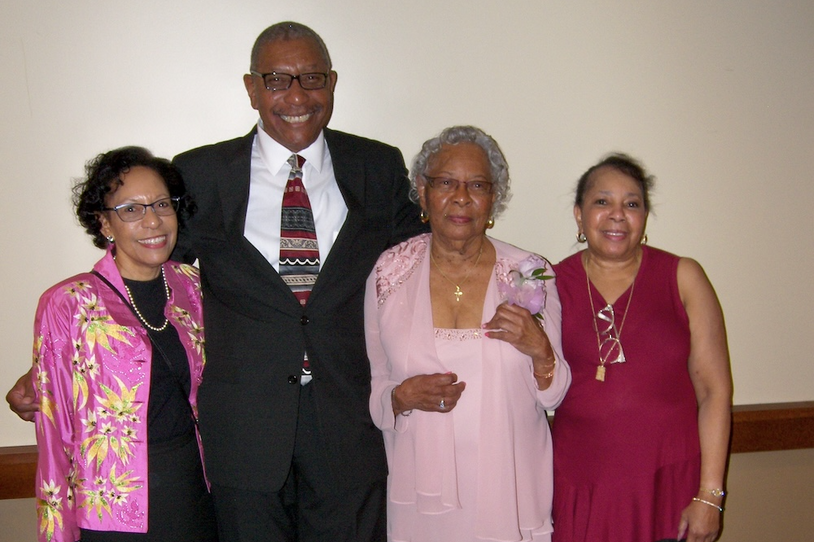
From left to right: Christine, Bruce, Rochelle, and Sherry.
Every morning, Rochelle starts her day with a nudge from her cat, Cosmo, a cup of coffee and time reading scripture. Then comes the daily Jumble puzzle, which has become a friendly competition with her son. Rochelle tries to solve it before he gets a look — and says she usually wins.
At 98 years old, Rochelle enjoys staying mentally sharp and credits her family with helping her stay active and connected. Her three children, Bruce, Christine and Sherry, are a strong support system, whether she needs help with the computer or a ride to an appointment. Her family is also part of her experience with the Parkinson’s Precision Medicine Initiative (PPMI), joining her for the study’s annual celebration for participants at the University of Rochester.
Rochelle joined the study as a control volunteer at the University of Rochester in 2010, the year the study launched. While she didn’t join because of a personal connection to Parkinson’s disease, she was curious about her own health and appreciated the opportunity to contribute to research that could help others.
[The landmark PPMI study is working to better understand how Parkinson’s starts and changes over time. People with and without Parkinson’s can contribute in different ways. Learn more.]
A Chance to Help Others and Track Own Health
Rochelle has spent much of her life working with people. Her career included working as a mental health case manager, where she trained people to live independently, serving as a social services investigator, and later as assistant secretary for the New York State Department of Human Rights.
Research was not entirely new to Rochelle when a colleague introduced her to PPMI. She had previously participated in flu research, but PPMI stood out because of its long-term nature. She liked the idea of having another team, alongside her own healthcare providers, following her health and taking note of changes over the years.
“I liked that someone would be watching my health over time,” Rochelle said.
Earlier this year, Rochelle completed her 22nd PPMI study visit. Her annual study visits include questionnaires, blood samples and other assessments, with occasional remote visits in between. She especially enjoys the cognitive assessments, which she sees as another way to keep track of how she’s doing.
A Way to Bring Answers to Everyone
Her years in PPMI have also given Rochelle a perspective on who is represented in research, and who may be missing.
“When we go to these yearly events, I’m usually the only Black person there,” she said.
Rochelle hopes to see more people of color participate in research. She wonders whether there may be differences in how Parkinson’s disease affects people from different backgrounds and believes those questions can only be answered if research includes everyone.
She thinks of her faith and her family: three children, four grandchildren, two great-grandchildren and one great-great-grandchild, most of whom live nearby in Rochester. She has made full-size quilts for each and relates participating in research to similarly piecing together personal history.
A Call for Others to Join
Rochelle hopes more people will recognize that participating in research offers an opportunity to learn more about their own health while helping researchers make discoveries that could benefit future generations. And she hopes more people from different backgrounds will take part.
“You can learn something about your own health, but what researchers learn from you may also help someone in the future,” says Rochelle. “That’s why it’s important for all of us to be represented.”
Find the right study for you. Fox Trial Finder connects people with and without Parkinson’s to research opportunities.