

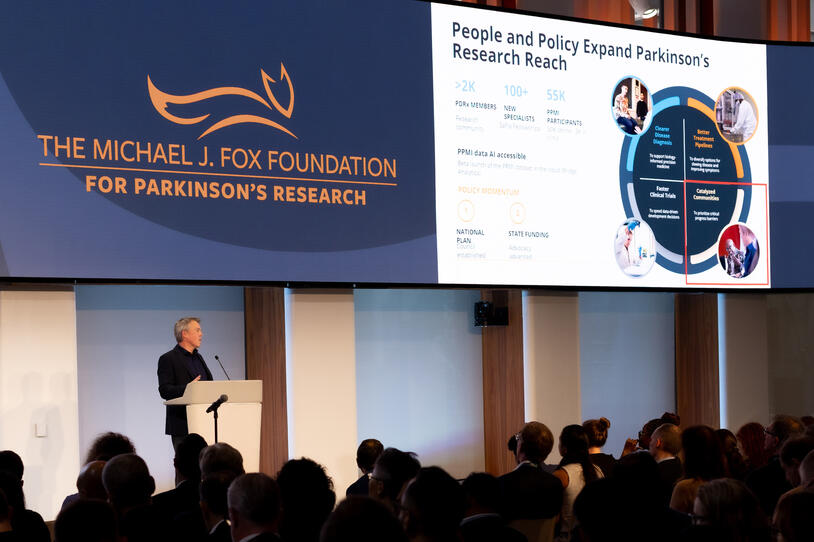
Chief Scientist Mark Frasier, PhD, shares how MJFF resources can help speed new therapies, setting the stage for collaboration and knowledge-sharing among researchers and industry leaders on Day 1 of the 18th annual PDTC.
Each year, The Michael J. Fox Foundation (MJFF) hosts the Parkinson’s Disease Therapeutics Conference (PDTC), the world’s only scientific meeting devoted exclusively to Parkinson’s drug development. Bringing together researchers, biotech leaders, pharmaceutical partners and funders, PDTC provides a unique forum to share insights, spark collaborations and explore new opportunities to advance the next generation of treatments.
Now a two-day event, the 18th annual PDTC took place on October 14 and 15, 2026, drawing nearly 400 attendees from 180 institutions and marking its largest gathering to date. Day 1 highlighted MJFF’s role as a catalyst across the Parkinson’s community, giving attendees a closer look at the Foundation’s expanding ecosystem of research programs, data platforms and scientific resources that can help speed the translation of promising science into potential therapies.
“At the Foundation, we are conveners, we are enablers, we are facilitators, and we really want to create this environment that accelerates therapeutic development for Parkinson’s disease,” said MJFF Chief Scientist Mark Frasier, PhD. “Our vision is to go out of business and have a world without Parkinson’s. It’s a tremendously exciting time in Parkinson’s research.”
By connecting the people, resources and expertise needed to tackle the toughest challenges, MJFF continues to help create the conditions for therapeutic innovation. Day 1 gave funders and investors the chance to engage directly with MJFF-supported grantees, while showcasing five ways the Foundation is equipping the field to move more quickly toward better Parkinson’s treatments.
De-Risking the Next Generation of Parkinson’s Drug Targets
The Parkinson’s field is identifying a growing number of potential drug targets, but determining which are most likely to lead to successful therapies remains a major challenge. MJFF’s Targets to Therapies was created to address that gap by systematically evaluating promising targets, identifying critical needs and generating the evidence required to advance the strongest opportunities. To date, the program has assessed more than 290 targets and selected 23 for further study, while continuing to solicit input from across the field.
A cornerstone of the effort is the Target Knowledge Base, which compiles evidence on target biology, genetics, druggability and preclinical research in a single platform. The resource allows investigators to compare target profiles, identify unanswered questions and determine where additional validation is needed. “We want to make sure that the data doesn’t stay within a single lab or with a single researcher,” said MJFF Senior Scientific Portfolio Manager Allie Vaiana. “We want to get that data out to the community so that we can make informed decisions.”
By combining expert evaluation, open science and a growing suite of supportive, decision-making tools, Targets to Therapies is enabling smarter investment decisions, de-risking drug discovery and accelerating the development of potential new treatments.
Reshaping Parkinson’s Clinical Trials through PPMI
Since its 2010 launch, MJFF’s Parkinson’s Progression Markers Initiative (PPMI) has generated the data, biomarkers and biological insights needed to transform Parkinson’s research and drug development. Reflecting the field’s increasing focus on matching therapies to disease biology, PPMI recently changed its name to the Parkinson’s Precision Medicine Initiative. Its goal remains ambitious: moving beyond broad clinical diagnoses toward a future where treatments are tailored to those most likely to benefit. As PPMI Principal Investigator Kenneth Marek, MD, put it, a key objective is identifying “the right participant for the right therapy.”
Speakers highlighted how PPMI and related MJFF infrastructure are laying the groundwork for more precise and effective clinical trials. Its growing dataset — available to investigators worldwide and spanning the full continuum of disease — is being used to identify trial participants earlier, define biologically meaningful patient populations, predict progression, develop more sensitive endpoints and produce evidence for regulatory engagement. These advances reduce risk for drug developers and open the door to testing therapies at the earliest stages of disease, including through the upcoming MJFF-sponsored Path to Prevention platform trial.
Creating New Biomarker Tools and Resources
As Parkinson’s drug development becomes increasingly focused on specific biological pathways, MJFF is building new capabilities to help researchers select, evaluate and apply the most informative biomarkers in their studies. Highlighted this year was an updated, interactive biomarker landscape report and pathway-specific toolkits designed to support biomarker strategy in early-stage clinical trials.
These offerings focus on pathways such as LRRK2, GBA and NLRP3, guiding teams toward assays that measure target engagement, pathway activity and treatment response. The interactive report is being developed as a searchable platform that lets users filter biomarkers by pathway, context of use and level of validation, while the targeted toolkits provide guidance on assay selection, supporting evidence and clinical implementation. Together, they bring greater clarity and consistency to biomarker selection, making it easier to compare available approaches, assess the strength of evidence and incorporate biomarkers into therapeutic development programs.
Harnessing Big Data to Drive Precision Medicine
From genetics and transcriptomics to proteomics and spatial biology, Parkinson’s researchers now have access to an unprecedented volume of molecular data. Datasets generated through initiatives such as Aligning Science Across Parkinson’s (ASAP), in partnership with MJFF, like the Global Parkinson’s Genetics Program (GP2), Collaborative Research Network (CRN), and PPMI are helping scientists move beyond viewing Parkinson’s as a single disease and instead identify the distinct biological pathways driving symptoms and progression in different patient groups. By integrating these multimodal datasets, researchers can uncover new therapeutic targets, define meaningful patient subtypes and discover biomarkers that could improve clinical trials.
Speakers at PDTC underscored how these resources can connect genetic variation, molecular signatures and clinical outcomes, creating new ways to match therapies with the patients most likely to benefit. As researchers revisit years of data using new analytical tools and biomarker frameworks, they are beginning to unlock markers of disease progression, cognitive decline and treatment response that may have been previously overlooked. The growing ability to stratify participants based on underlying biology rather than symptoms alone is enabling more targeted trial designs, stronger biomarker development and a more personalized future of Parkinson’s care.
Bringing the Patient Voice Earlier into Drug Development
The most effective clinical trials begin long before the first participant enrolls. A PDTC discussion explored how incorporating the perspectives of people with Parkinson’s earlier in research and development can strengthen decisions throughout the process, from treatment delivery and study procedures to eligibility criteria, recruitment strategies and participant burden.
“What is the lived experience of Parkinson’s? What are current gaps? What are unmet needs? How do people think about the risk-benefit of being in a trial?” asked Maggie Kuhl, vice president and head of patient engagement at MJFF. “Those are the questions that patient experience data can help answer.”
MJFF offers a range of resources to help companies gather those insights throughout development. Through Fox Insight, Fox Trial Finder, patient advisors, surveys, focus groups and recruitment support, the Foundation can connect researchers directly with the Parkinson’s community to refine study designs, assess feasibility and address common barriers to participation, such as travel demands, burdensome visit schedules, invasive procedures, reimbursement challenges and complex enrollment materials. By integrating patient perspectives earlier and more consistently, MJFF aims to make clinical trials more accessible, efficient and responsive to the needs of the people they are intended to serve.
The 2026 Parkinson’s Disease Therapeutics Conference was made possible through the generous support of our event sponsors. To learn more about sponsorship opportunities or ways to get involved in next year’s event, please contact [email protected].