

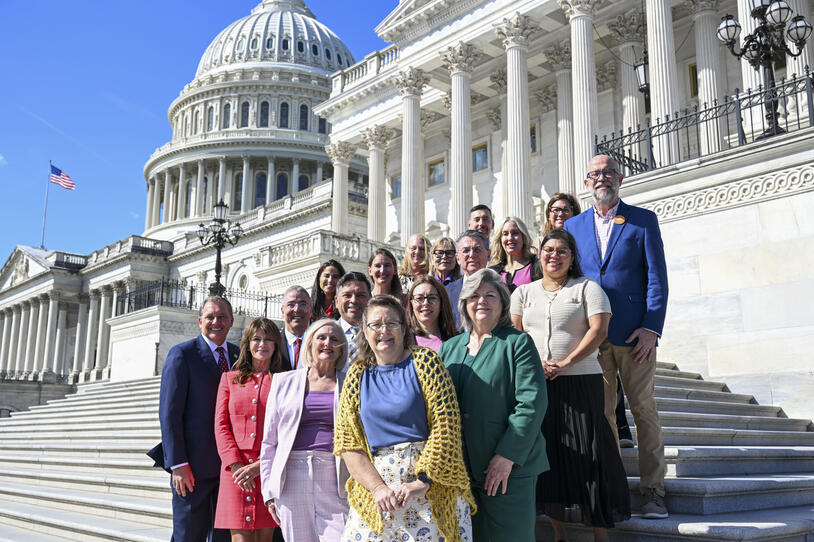
Tennessee and Texas advocates on Capitol Hill during the 2025 Parkinson's Policy Forum.
For people living with Parkinson’s disease — and for the families, friends and care partners who love them — progress depends not only on scientific discovery but also the public policies that help fuel those discoveries and protect public health.
In 2026, The Michael J. Fox Foundation (MJFF) and our nationwide network of advocates are leading a focused policy agenda that builds on recent advancements and keeps Parkinson’s front and center for key decisionmakers in Congress and in states across the country.
“We’re on the brink of something big in Parkinson’s,” said Michael J. Fox. “Research is moving faster than ever. Advocates are raising their voices. Champions on both sides of the aisle are stepping up. The Fox Foundation stands ready to partner with the government to seize this moment and deliver the breakthroughs millions of Americans are waiting for.”
“The Fox Foundation stands ready to partner with the government to seize this moment and deliver the breakthroughs millions of Americans are waiting for.”
Read on to learn more about our 2026 policy priorities and sign up to join us as an advocate today.
Building on Strong Momentum in Federal and State Research Funding
Public research investment is essential for developing new Parkinson’s treatments. Federal research funding often supports large-scale, foundational science at agencies like the National Institutes of Health (NIH), while state research commitments can help launch new ideas and build local research capacity.
State Research Investments
In 2025, advocates powered major state-level wins that will support Parkinson’s research for years to come. Texas voters approved a landmark $3 billion investment in brain disease research over 10 years — one of the largest state research commitments in U.S. history. Pennsylvania included $5 million for neurodegenerative disease research in their 2026 budget, and Florida created a new Parkinson’s research consortium at the University of South Florida (USF) with $8 million to begin operations.
This year, MJFF is building on this progress by pursuing ambitious new and expanded investments in states across the country. In California, MJFF is supporting legislation to establish a new $23 billion state-based research fund, which would dramatically expand resources for biomedical and brain disease research if approved by voters in November. In Florida, MJFF is working with legislative and university partners to expand funding for the USF research consortium.
Additional priority states include New York, Tennessee and Utah. In states like Iowa and Minnesota, lawmakers are pursuing Parkinson’s research funding commitments alongside complementary environmental health protection policies.
Federal Research Investments
Strong, increased research investment is critically needed to meet this opportune moment in scientific progress. That’s why we’re laying the groundwork to accelerate investment in Parkinson’s research at the NIH to at least $600 million annually by fiscal year (FY) 2028. NIH investment in Parkinson’s and atypical parkinsonism research has remained relatively flat over the last five years, at around $330 million per year.
Last summer, MJFF partnered with other leading Parkinson’s organizations to call on Congress to robustly fund the NIH in the FY 2026 budget. Advocates reinforced that message by writing, calling and meeting with lawmakers. On February 3, 2026, Congress passed a key funding bill that included a $400 million increase for the NIH, signaling bipartisan support for biomedical research. Though this increase doesn’t create new Parkinson’s-specific research programs, our advocacy helped ensure the NIH can continue to play its essential role in the national biomedical research landscape. We remain committed to pushing for more support for Parkinson’s research at every turn.
The FY 2026 federal budget also includes:
- A new $5 million commitment for the National Parkinson’s Project (NPP), ensuring the U.S. Department of Health and Human Services and NIH have the resources needed to begin critical implementation steps, including coordinating the NPP Advisory Council and delivering required reports to Congress.
- Restoration of $16 million for the U.S. Department of Defense’s Parkinson’s Research Program, which was eliminated the year prior. MJFF mobilized advocates to urge Congress to reinstate this program, which seeks to understand and prevent military-related risks for Parkinson’s like traumatic brain injury and environmental exposures.
Confronting Environmental Risk Factors
A growing body of scientific evidence links certain environmental exposures to an increased risk of developing Parkinson’s disease. Among those of greatest concern is paraquat, a highly toxic herbicide that is banned in more than 70 other countries but remains in use in the United States.
In 2026, MJFF and our partners are working with advocates to advance legislation to restrict or ban paraquat in Illinois, Iowa, Minnesota, Missouri, New Jersey, New York, Pennsylvania, Vermont, Virginia, West Virginia and Washington.
On the federal level, MJFF continues to urge the U.S. Environmental Protection Agency to restrict or ban the use of Parkinson’s-linked chemicals like paraquat. We are also supporting bipartisan legislation like the HEALTHY BRAINS Act, which would direct the NIH to research the relationship between environmental risk factors and neurodegenerative diseases including Parkinson’s, Alzheimer’s and ALS. The bill, initially introduced last Congress, did not advance before the session ended but is expected to be reintroduced soon.
This work is grounded in rigorous science and strengthened by advocates who share their personal experiences with policymakers. MJFF also works in coalition with environmental and public health organizations who share our commitment to eliminating preventable exposures and protecting brain health.
Influencing and Advancing the National Parkinson’s Project
The NPP is a once-in-a-generation opportunity to align and coordinate federal efforts to better understand, treat and ultimately prevent Parkinson’s disease. Authorized by the bipartisan National Plan to End Parkinson’s Act, the NPP was made possible by years of sustained advocacy from the Parkinson’s community.
Now, MJFF aims to ensure that as implementation of the NPP begins, the initiative incorporates scientific opportunity and the needs of Parkinson’s patients, families and caregivers. Our immediate priorities for the NPP include the seating of the NPP Advisory Council, the release of required assessments to Congress and clear accountability around the initiative’s goals and outcomes.
The Power of Advocacy
Advocates remain at the heart of every policy win. In 2026, MJFF will continue growing and strengthening the Parkinson’s Policy Network (PPN) — engaging new voices, expanding participation in key states and congressional districts and ensuring advocates have the tools and support they need to advocate with confidence.
“The Parkinson’s advocate community is getting louder every year, because those most affected are leading the charge — and they’re showing up in a major way,” said Dan Feehan, MJFF’s Chief Policy and Government Affairs Officer. “They join us to testify for state legislation. They fly to Washington, D.C. to meet face-to-face with their Congressmembers. They pitch their stories to local reporters and share our calls to action on social media. In 2026, our job is to create and clear the path to even more opportunities for advocates to make their voices heard. If you haven’t joined us yet, there’s no better time than the present.”
“In 2026, our job is to create and clear the path to even more opportunities for advocates to make their voices heard. If you haven’t joined us yet, there’s no better time than the present.”
From state lobby days to the annual Parkinson’s Policy Forum on Capitol Hill and the virtual Parkinson’s National Day of Action (save the date for April 7!), advocates help ensure that policy decisions are grounded in the diverse lived experiences and needs of our community.
By joining the PPN, you’ll receive timely updates on policy developments and opportunities to take action at your own pace. Whether you’re living with Parkinson’s, supporting someone who is or simply believe in the power of advocacy to drive research outcomes, your voice matters. Sign up at michaeljfox.org/advocacy!