

The innovative research initiative fills knowledge gaps on understudied avenues for slowing or stopping the disease.
The Targets to Therapies Initiative, a Michael J. Fox Foundation (MJFF)-led effort devoted to learning about promising “targets” for new drugs to treat Parkinson’s disease (PD), has awarded its first grants. The grants fund research to reveal the utility of five targets for urgently sought disease-modifying drugs.
Disease-modifying therapies, which target the biology that underlies Parkinson’s neurodegeneration and the resulting symptoms, remain the greatest unmet need for people with the disease.
“This is a major effort to stimulate innovation and strategically expand the number of targets for drugs with potential to slow or stop Parkinson’s from getting worse,” said Gaia Skibinski, PhD, director of translational therapeutics at MJFF. “By systematically identifying and testing targets, Targets to Therapies holds immense promise to lead us toward a better future for people and families with Parkinson’s.”
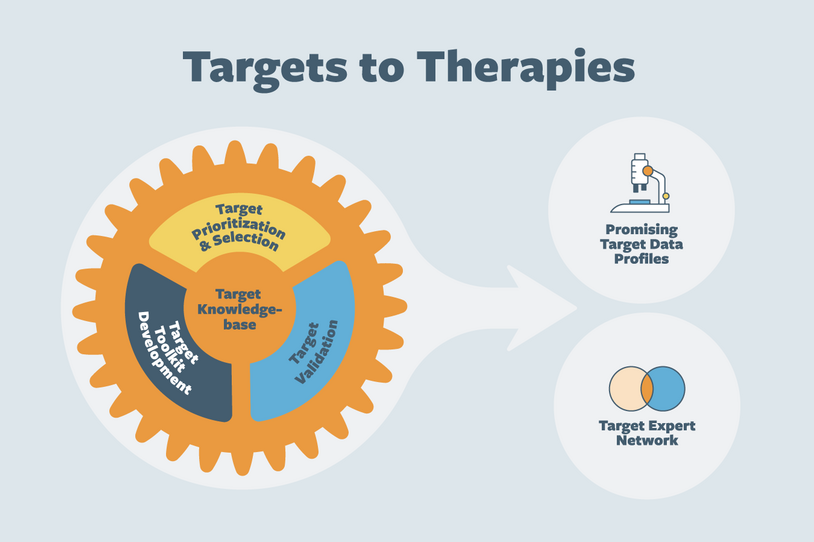
The initiative is focused on building critical evidence for promising but understudied therapeutic targets. It focuses on determining and validating whether specific proteins or genes within biological mechanisms involved in PD could serve as effective targets for PD drugs.
Well-known examples of these targets that have therapies already in clinical trials include alpha-synuclein, GBA1 and LRRK2. Ongoing clinical trials are testing drugs for these advanced targets in people with PD. However, scientists suspect hundreds more targets impact PD — either by improving symptoms or modifying the disease itself — and could function as valuable therapeutic targets.
Building off a top-down target prioritization approach (described in a recent publication in npj Parkinson’s Disease), the Targets to Therapies Initiative consults with research experts in the global PD scientific community to select a subset of targets for additional research. Then it funds that research in hopes that it will yield information that supports advancing the targets in clinical testing. The dynamic initiative employs a collaborative approach that unites experts in the work of evaluating, nominating and validating targets and makes learnings and tools freely available through a shared knowledgebase.
The First Five Targets
In its first round of funding, the initiative is investing $19 million to de-risk five high-potential targets and drive development of cross-target tools. The first targets are:
NOD2, a gene that acts as a sensor detecting bacteria and triggering inflammation in the brain and gut. In PD, NOD2 may become abnormally activated by alpha-synuclein, the protein that clumps in the PD brain, and other stresses. A therapy that reduces this NOD2 activity could protect dopamine neurons so they don’t die.
TMEM175, a gene that when faulty can disrupt the cell’s waste disposal systems, leading to buildup of toxic substances in neurons. A therapy that activates TMEM175 could enhance cellular recycling and break down clumps of alpha-synuclein so that they aren’t so toxic to dopamine neurons.
ATP13A2, a gene that, when it carries a mutation, is a rare cause of early-onset Parkinson’s disease. Activating ATP13A2 could improve cell functioning in ways that prevent alpha-synuclein from accumulating and becoming toxic.
TRPML1, a protein that forms channels on cell membranes and, when activated, may clear alpha-synuclein clumps from cells before they endanger dopamine neurons.
OGA, a protein that, when inhibited, may prevent alpha-synuclein and the degeneration of dopamine neurons, a key contributor to PD’s symptoms.
So far, $7.5 million has been awarded to these target validation projects plus generation of cross-target research tools, with up to an additional $11.5 million expected to be committed. Additional rounds of funding are scheduled for 2026 and 2027.
Because only some of these mechanisms are likely to work as targets for drugs that effectively slow Parkinson’s, investing in research to learn more about them is risky, holding no guarantee of success. But the only way to find out which are promising targets for new drugs is to fill fundamental knowledge gaps on them. When successful, this so-called “validation” research can generate evidence that builds confidence in targets and attracts larger investments to advance clinical testing.
Selection Process for Identifying Top Targets
Prior to this first round of funding, the initiative used surveys to gather input from the scientific community on potential targets for PD therapeutics. The surveys returned more than 280 targets that are associated with PD biology and that scientists felt, with additional research, could be homed in on by new drugs.
The paper published earlier this year described the in-depth process for identifying and prioritizing the priority targets using input from the Parkinson’s research community. In it, the authors described how by supporting the systematic evaluation of the selected targets’ biological relevance, translatability and therapeutic potential, the Targets to Therapies Initiative can build the confidence needed to move them toward drug development and trials that assess their clinical impact.
MJFF encourages the global research community to engage with the Targets to Therapies Initiative and contribute insights that will shape the future of PD therapeutics, both by participating in ongoing knowledge collection efforts and by offering relevant expertise.
Researchers with an interest in working with us on specific targets can complete a short Target Interest Form. MJFF research staff will evaluate submitted interest forms and, when there is a fit, reach out for additional information. To nominate a target that is not on the list and that we should know about, please send an email to [email protected].
Driving Innovations in Drug Development
The initiative is a key component of MJFF’s efforts to improve and accelerate the drug development pipeline, bringing new treatment options for people with Parkinson’s that address both the progression of PD as well as the most challenging symptoms. It grew from recognition of two key factors affecting the future of PD treatment. The first is that PD is a diverse, complex disease, so even with a pipeline filled with a robust selection of approaches targeting PD’s underlying biology — including alpha-synuclein, LRRK2 and GBA1 — a broader range of therapeutics may be needed. The second is that researchers have identified many potential therapeutic targets, but many of these targets lack the validation data needed to attract interest and investment in their therapeutic development.
MJFF Urges Investigators to Partner with Targets to Therapies
Learn more about the Targets to Therapies Initiative and read the recent npj Parkinson’s Disease paper outlining the in-depth selection process.
To express interest in working with us on specific targets, complete a Target Interest Form.
If you’re interested in the knowledgebase tool, please apply for access using the Targets to Therapies Knowledgebase Access Request form.
Sign up to join a town hall on STING, TREM2 and TLR2, scheduled for December 8, 2025. The town hall will overview the Targets to Therapies Initiative in more detail, discuss validation strategies and key gaps for each target and introduce opportunities for funding and collaboration.
Email [email protected] to get in touch with the Targets to Therapies team.