

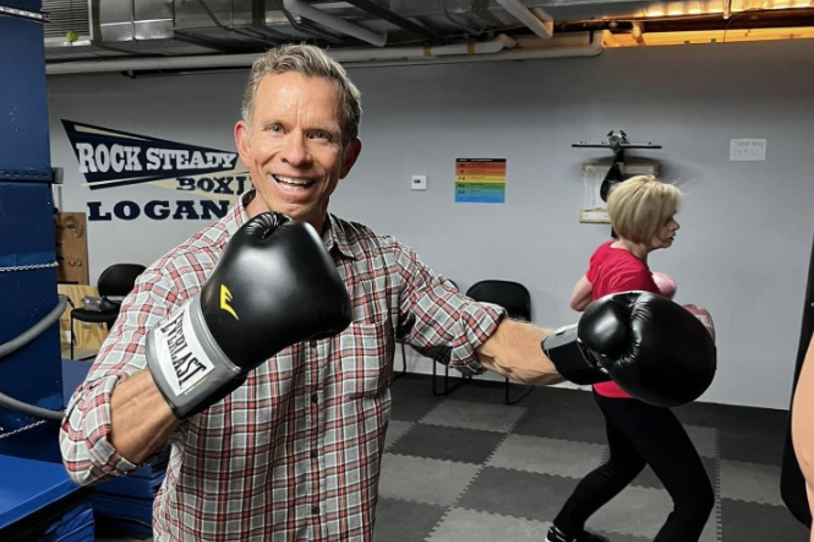
Kim Lundgreen practices boxing in the gym.
My name is Kim Lundgreen. I just turned 68. I was diagnosed with Parkinson’s disease in 2017 at the University of Utah’s Movement Disorder Clinic in Salt Lake City. I remember thinking, “What a strange name for a place.” My wife, Mindy, was 50 at the time. She cried when we heard the diagnosis. I was stunned. Shocked. My first reaction was dramatic but honest: “If I can’t run anymore, I’ll go to Yosemite and base jump off El Capitan without a parachute.” That’s how much running meant to me. I used to say this for years to anybody who would listen!
Running was more than exercise. It was my therapy, my prayer time, personal solitude time, my way of solving the world’s problems. I was an ultramarathon runner with nearly 50 marathons and ultramarathons under my belt. I ran the St. George Marathon 25 years in a row. I once beat ultramarathon legend Dean Karnazes at the finish line there during his famous 50/50/50 tour. That moment qualified me to run Boston two years later.
This June (after Cassie Webster, my Rock Steady Boxing coach kept encouraging me for years to try) I completed the Logan Peak Trail Run with a right sprained ankle, an ultra-distance race of 28 miles with over 7,000 feet of elevation gain with virtually no training. It was my first race in five years. Parkinson’s had forced me to stop running altogether. Symptoms like rigidity, cramping, and neuropathy made training nearly impossible.
But I fought my way back. A news article in the Herald Journal highlighted the run. KSL News out of Salt Lake City, after getting wind of my seemingly impossible feat, covered my successful summit of the Middle Teton via the Southwest Couloir which I achieved just a couple weeks prior. We climbed at night with headlamps, ice axes, and micro-spikes. My “soul brother” David Toone saved my life more than once on that descent as my symptoms kicked in. Exhaustion, vertigo, and total fatigue set in hard.
Two years after my diagnosis, in the fall of 2019, Mindy received devastating news of her own: serious ovarian cancer. We had no warning, and the shock was overwhelming. Suddenly, we were both facing life-threatening diseases, and the reality of our situation hit hard. We both wept together when Mindy’s doctor gave us the grim news while we were shopping together.
In that moment, I felt a heavy burden of responsibility. I had to be strong for Mindy, and I also had to manage my own Parkinson’s. We were both in for the fight of our lives. Mindy was only 52, and I had just turned 62. Our dreams for our golden years felt shattered. I remember lying awake that night, overwhelmed by a sense of doom. I prayed to God, “Why now? Isn’t Parkinson’s enough for us?”
I lost Mindy my beautiful wife of 23 years in 2024 to ovarian cancer after a brutal five-year fight. She was only 57. We were both strong, active, and healthy. We mountain biked, ran trails, paddle-boarded, lifted weights, practiced yoga, and stayed committed to our physical and spiritual health. Experiencing loss with Parkinson’s is horrible, however movement and exercise— especially weight-lifting, trail running combined with my Rock Steady Boxing now are so vital for me in providing hope and light each new day!
Parkinson’s disease is relentless. The only real weapon against Parkinson’s is movement. Exercise, especially strength training and cardio, has been shown to slow the progression of the disease. I’ve made intense exercise a daily part of my routine, seven days a week. It’s the “silver bullet” that keeps me fighting, and I’m convinced it’s the key to maintaining a good quality of life while living with PD. Also, it is so helpful to me in coping with Mindy’s death.
Mindy and I thought we’d grow old together. We didn’t see this coming.
Now, I carry her with me through every climb, every run, and every battle with Parkinson’s.
___________________________________
Editor’s Note: The Parkinson’s journey can feel isolating at times, both for those living with PD and their loved ones. Access the Parkinson’s Buddy Network, an online community of people impacted by Parkinson’s, that was designed to help individuals and families make meaningful connections, engage in important dialogue, find useful resources and build long-lasting relationships.
Check out The Michael J. Fox Foundation’s resources for people newly diagnosed here. Additionally, check out the Foundation’s easy-to-read, downloadable guides, where movement disorders neurologist Rachel Dolhun, MD, and other experts provide practical tips and real-world advice for navigating life with Parkinson’s disease.
Photo Gallery

Kim Lundgreen with his grandchildren and late wife, Mindy.
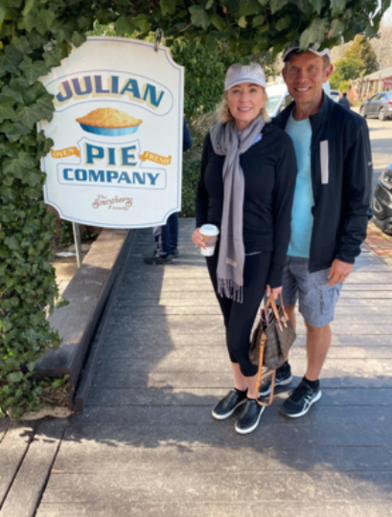
Kim Lundgreen with his late wife, Mindy.
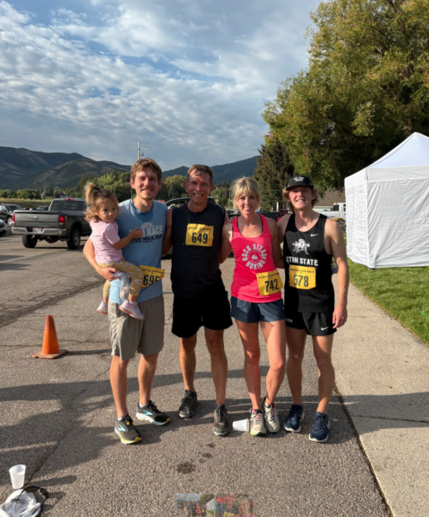
Kim Lundgreen with family and friends at a race.
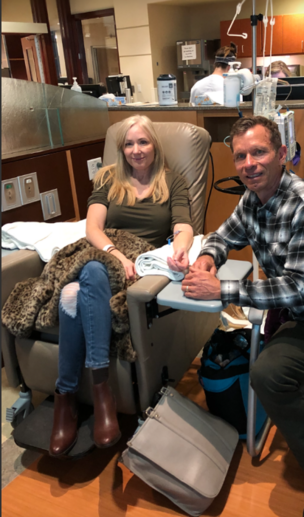
Kim Lundgreen by his late wife, Mindy’s, side as she received treatment.