

“Many people think of a tremor as the quintessential warning sign of Parkinson’s disease. But other symptoms — many of them not involving changes in movement — can appear much earlier than what’s known as a resting tremor.”
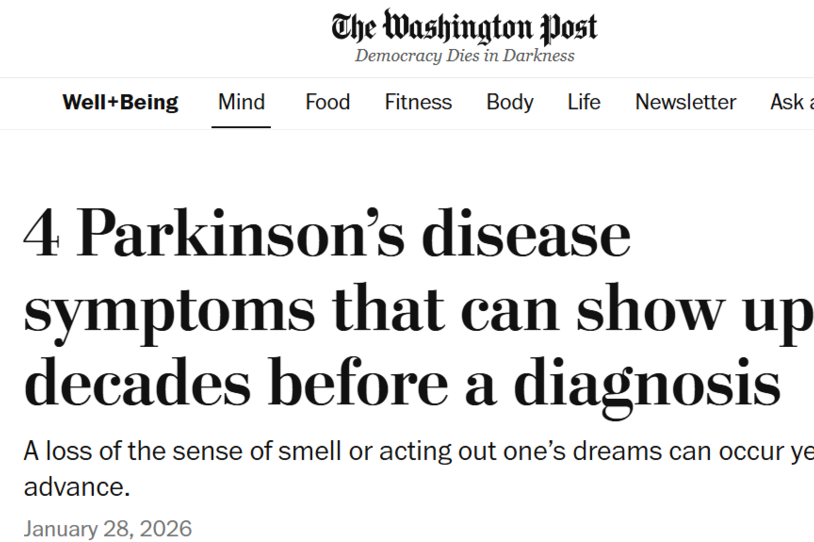
In a recent Washington Post article, “4 Parkinson’s Disease Symptoms That Can Show Up Decades Before a Diagnosis,” freelance science writer Meeri Kim examines the strides researchers have made over the past two decades in identifying markers of prodromal Parkinson’s.
The piece features an interview with the Foundation’s Principal Medical Advisor, Rachel Dolhun, MD, DipABLM, who highlights early warning signs that are often overlooked but can precede motor symptoms by more than a decade.
“Parkinson’s is what we call a movement disorder because it affects our movement, but there’s a whole side of Parkinson’s that is non-motor,” said Dr. Dolhun. “We long thought it was just a movement disease, but now we see that it affects the whole body in different ways.”
As Kim emphasizes in the article, neurologists often look for characteristic movement symptoms including slowness, stiffness and resting tremor to make a Parkinson’s diagnosis, however, non-motor symptoms such as loss of smell, REM sleep behavior disorder, chronic constipation and drops in blood pressure upon standing often appear early in people who are later diagnosed with Parkinson’s disease.
“It’s important to stress that not everyone who has these symptoms goes on to develop Parkinson’s,” Dolhun said. “But we know that in some people, these can be some of the earliest signs.”
Smell Loss
Smell loss affects more than 90% of people living with Parkinson’s, gradually over time, often beginning years or even decades before motor symptoms. Researchers are still trying to understand the links between Parkinson’s and the loss of sense of smell, known as anosmia.
Adults age 40 and older in the United States or Canada who have not been diagnosed with Parkinson’s disease can play a unique role in helping researchers learn more about this connection. People looking to get involved in research can request a free scratch-and-sniff test from The Michael J. Fox Foundation for Parkinson’s Research.
The test offers an easy way for people to learn more about their own sense of smell and, if they choose, to share their results through the Foundation’s landmark research study, the Parkinson’s Progression Markers Initiative (PPMI). Shared results help researchers better understand early markers of Parkinson’s and may help identify individuals who could be eligible for additional research opportunities in the future.
REM sleep behavior disorder
REM sleep behavior disorder (RBD) is a chronic condition where people physically act out their dreams, often sitting up in bed, having one-sided conversations or even punching or kicking their partner. RBD can be one of those first symptoms of Parkinson’s, occurring years before a diagnosis. As Kim highlights in the article, people ages 50 and older with RBD have a 130 times greater likelihood of developing Parkinson’s compared to someone without the sleep condition.
Individuals looking to learn more about RBD can visit the Foundation’s webpage here.
People with RBD can play a critical role in research by participating in the Foundation’s PPMI research study, which is currently seeking participants who are age 18+ with RBD, living with or without Parkinson’s, to follow them over time. PPMI aims to better understand and measure Parkinson’s disease, including its earliest stages before movement symptoms begin. Examining Parkinson’s risk factors like RBD can provide information that could lead to new treatments. To learn more, click here.
Chronic Constipation
While constipation is one of the most common gastrointestinal complaints in the United States, chronic constipation that persists for several weeks or longer affects two-thirds of all people with Parkinson’s. Constipation is believed to affect the nerves that line the digestive tract, and studies have found clumps of abnormal protein in neurons lining the intestines of people with Parkinson’s.
Researchers are working to learn how and why constipation happens in Parkinson’s and how an individual’s unique gut bacteria (microbiome) play a role in symptoms, disease and medication effect.
To better understand the occurrence and impact of symptoms, including constipation, MJFF is gathering data from people with and without Parkinson’s through its online clinical study Fox Insight. Register today to contribute valuable information through questionnaires and surveys.
Dizziness Standing Up
A drop in blood pressure that occurs when a person goes from sitting to standing, known as orthostatic hypotension, is common, but when chronic and persistent, it can be more serious. Researchers have identified orthostatic hypotension as a possible symptom of prodromal Parkinson’s, although the evidence is not as strong as other markers.
Research Participation Plays a Critical Role in Parkinson’s Science
While these symptoms don’t definitively diagnose Parkinson’s on their own, their presence – especially in combination with a family history – might indicate a higher risk for PD. The article highlights ongoing efforts to better understand these early markers in hopes of improving earlier detection and care.
Participation in research plays a critical role in advancing Parkinson’s science and provides valuable information on how the disease progresses over time. Whether or not you are currently living with Parkinson’s or experiencing early symptoms, your participation in research can help accelerate breakthroughs that benefit people living with and at risk for Parkinson’s.
Click here to learn more about participating in research.
Read the full story on The Washington Post.
Learn more about the Foundation’s landmark research study and enroll in PPMI here.
Register to take a free scratch-and-sniff smell test here.