

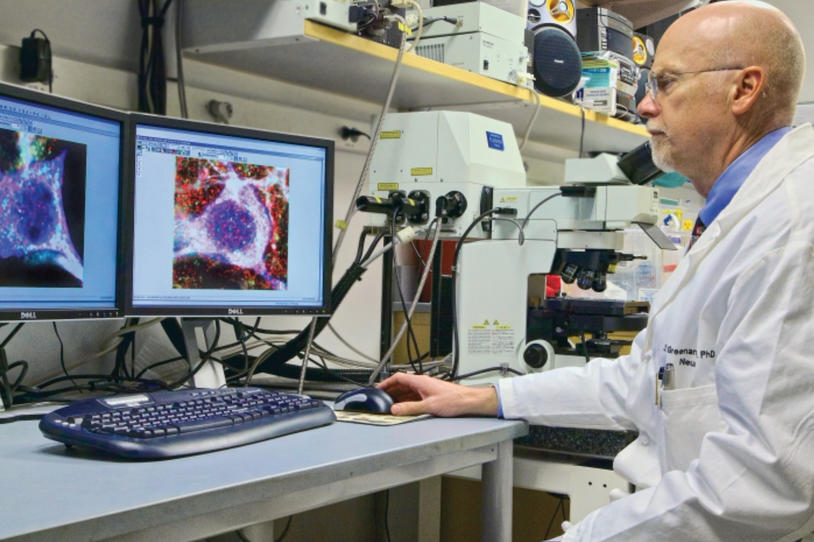
Timothy Greenamyre, MD, PhD in his research lab.
Parkinson’s researchers are using artificial intelligence (AI) to drive innovations that are helping uncover new biological patterns, reveal how Parkinson’s progresses and identify promising targets for treatment faster than ever before.
By analyzing massive, complex datasets, AI is leading to breakthroughs that could fundamentally change how we understand and treat Parkinson’s. AI models can spot early warning signs invisible to the human eye, predict how quickly someone’s symptoms might change, and help design smarter, more efficient clinical trials, which can move the field closer to precision medicine and, ultimately, prevention.
The Michael J. Fox Foundation (MJFF) is at the center of this AI-driven revolution. As the implementation partner for the Aligning Science Across Parkinson’s (ASAP) initiative, MJFF helps lead landmark studies like the Parkinson’s Progression Markers Initiative (PPMI) and the Global Parkinson’s Genetics Program (GP2). Through this strategic partnership, MJFF provides the rich, trusted data fueling this work.
Foundation-supported researchers are using AI to improve brain imaging, define biological subtypes of Parkinson’s, and accelerate drug discovery. Together, these efforts are turning data into discoveries that bring us closer to new treatments and a cure.
“AI is giving us a sharper, faster lens into Parkinson’s biology,” said Mark Frasier, PhD, Chief Scientific Officer at The Michael J. Fox Foundation. “By linking imaging, biomarkers and genetics into a single view, we can understand how this disease changes over time — and how to stop it.”
Using AI to Identify Patterns that Guide Parkinson’s Research
Artificial intelligence is especially powerful at finding patterns in complex biomedical data. AI is really a broad set of computational tools that help researchers look into deep data sets and find the most valuable insights. By analyzing thousands of measurements collected in studies like the Parkinson’s Progression Markers Initiative (PPMI) including imaging, genetics, clinical assessments and biosamples, AI can uncover relationships that help explain how Parkinson’s begins, why it varies from person to person, and where treatment opportunities may lie. Machine-learning tools can quickly sort through these massive datasets to highlight signals that would otherwise remain hidden.
“Machine learning brings new approaches to improve our ability to classify or predict outcomes based on complex biomedical research data sets,” said MJFF senior scientific portfolio manager Bradford Casey, PhD.
PPMI provides one of the world’s richest Parkinson’s datasets, and AI now helps link its many layers of information. By connecting patterns across imaging results, biological markers and genetic variants, all analyzed within strict privacy-protected research environments, AI can flag early biological signals, uncover potential subtypes, and improve predictions about how symptoms may change over time.
Researchers are increasingly using these tools to make sense of the study’s 15 years of data. More than 110 published papers have applied machine learning to PPMI, and recent work has used AI to cluster participants by biological similarities or progression speeds. These insights lay the groundwork for understanding Parkinson’s subtypes and mapping how the disease unfolds. These insights lay the groundwork for the next major question that AI helps answer: what biological “types” of Parkinson’s exist, and how does the disease change over time?
Because Parkinson’s affects people of many different backgrounds, the quality and representativeness of data going into the AI models matters. As Dr. Bradford Casey also noted, large datasets are only useful if they are consistent, complete and drawn from diverse participants. Otherwise, the results may not reflect real Parkinson’s biology or apply to everyone living with the disease.
AI Helps Reveal Parkinson’s Subtypes
No two people experience Parkinson’s disease the same way. Symptoms, progression rates and treatment responses can vary widely. AI helps researchers understand why by organizing large amounts of complex data into clearer answers.
By analyzing massive datasets from studies like PPMI including genetics, brain scans, spinal fluid measures, blood samples, clinical exams and wearable sensor data, machine learning models are identifying biological “subtypes” of Parkinson’s disease. For example, it can match certain gene variants with specific changes in brain chemistry or movement patterns recorded by smartwatches. These subtypes reflect differences in underlying biology, which may explain:
- Why some people progress slowly while others decline faster
- Why some develop tremor while others experience stiffness, sleep or cognitive changes first
- Why some respond to certain treatments while others do not.
Understanding these subtypes allows researchers to tailor therapies more precisely, such as enrolling people with similar biology in the same clinical trial, which makes it easier to see whether a treatment works.
These subtype insights build directly toward another powerful use of AI: predicting how Parkinson’s progresses.
Mapping Parkinson’s: AI Predicts Progression
AI is also helping forecast how the disease will progress in an individual, which is a major shift toward precision medicine.
Using more than a decade of PPMI data from over 2,500 participants, researchers have begun developing a machine-learning “disease map” that is designed to track how Parkinson’s unfolds across different systems of the body. This work is still in its early stages, but the goal is to create a map that acts like a GPS for the disease that shows where someone might be on their Parkinson’s journey and how quickly they may move forward.
A model created by Novartis researchers using PPMI data was recently highlighted at a session of the Parkinson’s Disease Therapeutics Conference (PDTC).
As this research continues to develop, the aim is for models like this to combine symptoms, imaging results, and biological markers into one shared timeline. In the future, such tools could help scientists:
- Identify fast versus slow progressors
- Detect which biological systems change first
- Enroll the right participants for the right trials
- Test therapies at the most effective moment
Scientists from other MJFF-funded programs are now adding even more layers, such as proteins and chemical compounds from blood and spinal fluid to refine this “disease map.” The goal is to eventually forecast how Parkinson’s will progress for each person and match them to the most effective treatments.
While AI helps forecast progression, it is also reshaping the tools researchers use to see Parkinson’s biology in the brain.
Untangling Genetics and Environmental Risk
AI is helping researchers understand one of the biggest questions in Parkinson’s research: Why does the disease start in the first place?
By analyzing data from the Global Parkinson’s Genetics Program (GP2), a resource program of the Aligning Science Across Parkinson’s (ASAP) initiative, AI can scan millions of genetic markers at once to find new risk factors and study how genes interact with the environment. In 2023, researchers using GP2 data discovered a new Parkinson’s risk gene in people of African ancestry. This finding was made possible by AI tools that can handle large and diverse datasets.
Today, scientists are combining these genetic insights with data on lifestyle and environmental exposures to see how each factor contributes to risk and how fast the disease progresses. This integrated view could help identify who is most at risk and when to intervene with preventative therapies.
These insights are crucial for early detection, prevention and ensuring that future treatments work for everyone, not just those historically included in research.
Prioritizing Parkinson’s Research Opportunities
AI further contributes to Parkinson’s research by making it easier to prioritize everything from gaps in literature to protein structure. This ensures limited research resources go to the most promising areas.
- Large Language Models (LLMs), like ChatGPT, can scan entire libraries of scientific papers to identify connections or overlooked ideas that could inspire new studies. While summaries still require human review, piecing together information from all aspects of Parkinson’s research makes it far easier for people to keep up with the breadth of scientific advances and how they might relate. Foundation teams are already using these approaches to pull together evidence on potential drug targets more efficiently, helping prioritize where to invest time and funding.
- Large Quantitative Models (LQMs) can analyze millions of numbers from lab test results to clinical records and uncover patterns that have gone unnoticed. This capability is especially valuable in distinguishing subtypes of Parkinson’s disease and pinpointing genetic markers associated with disease risk.
- AI-driven molecular modeling is helping scientists predict how potential drugs might interact with proteins that drive Parkinson’s biology. By simulating interactions at the protein level, AI-driven models help prioritize targets (specific parts of a protein, for example) for drug development, ensuring that resources are allocated to areas with the greatest potential for breakthroughs.
Together, these tools make Parkinson’s research more efficient and connected. AI helps scientists focus their time on the most promising questions and make sense of data that would otherwise take decades to sort through manually.
A New AI Landscape
Artificial intelligence is now woven into nearly every stage of Parkinson’s research, from discovering genes to designing clinical trials.
By combining human insight with computational power, researchers can uncover the hidden biology of Parkinson’s, design better therapies, and measure progress more precisely than ever before. At the same time, AI is not replacing scientists, doctors, or study volunteers. AI is a powerful tool that still depends on experts who understand Parkinson’s disease to ask the right questions, interpret results, and turn insights into real-world impact.
With the right data, expertise and investment, AI is helping us define Parkinson’s by its biology, predict its course and work toward stopping it before it starts. The Michael J. Fox Foundation is at the forefront of making the use of this technology more beneficial for people and families living with Parkinson’s.